
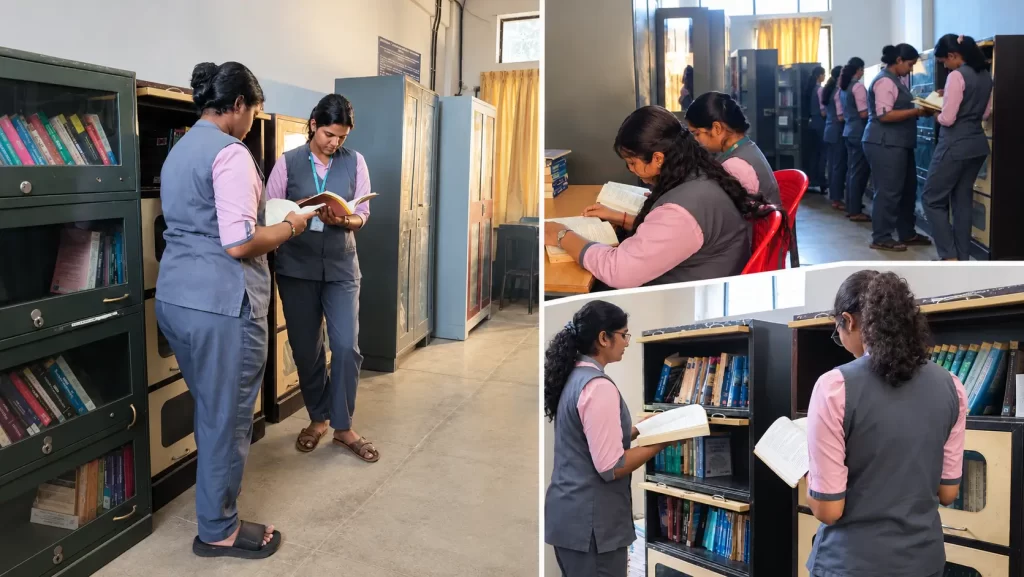
The Department Library is an essential academic resource centre supporting teaching, learning, research, and professional development. It houses a valuable collection of 1,371 books across 67 titles, covering core subjects and emerging areas of the discipline. The resources support students and faculty in classroom learning, assignments, seminars, projects, examinations, and research activities. The library also encourages students to develop reading habits, broaden their knowledge, and engage in self-directed learning.
The Department Library is accessible during the following hours:
Wednesday: 12:30 PM – 1:15 PM
Friday: 12:45 PM – 2:00 PM
The library continues to foster academic excellence, intellectual growth, and lifelong learning.
Apart from the above program specific laboratories CCF with following facilities are available.
Though the above mentioned labs have software and hardware adequate to meet the curriculum components, modern software tools/techniques are installed in CCF for enabling the students to give expertise to such tools and techniques.
A Central Computing Facility is available to access internet for students and faculty members.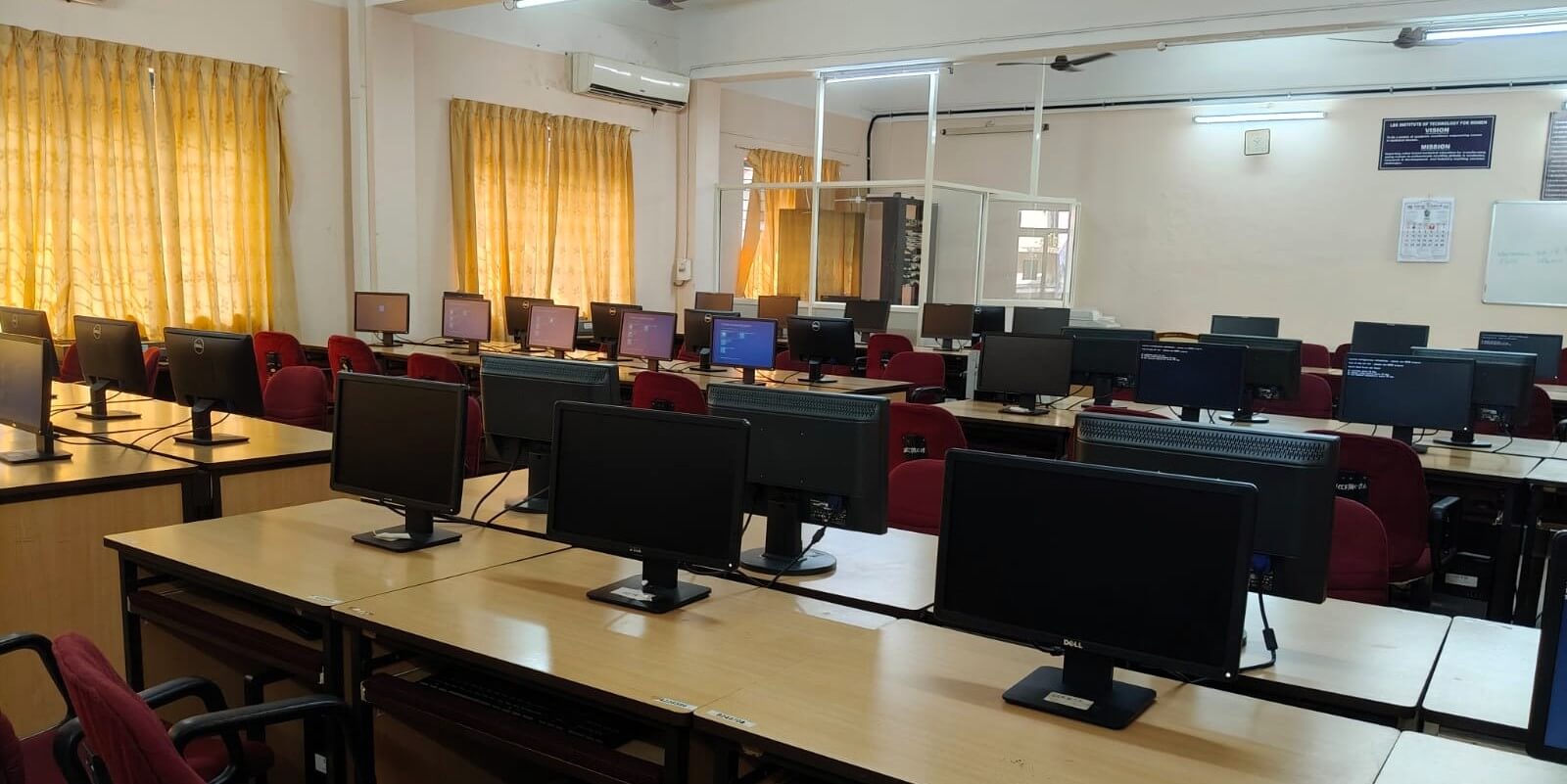
- Preamble
LBS Institute of Technology for Women, Poojappura (LBSITW) a premier women’s engineering institution, recognizes that research and innovation are critical to advancing knowledge, fostering societal development, and empowering women in technology and engineering. This Research Policy aims to create an enabling environment for faculty, students, and staff to engage in meaningful research, consultancy, innovation, and intellectual property creation that contribute to academic excellence and societal welfare.
- Vision
To establish LBSITW as a center of excellence in research and innovation, promoting womens’ participation in science and technology through impactful, ethical, and sustainable research practices.
- Mission
- To nurture a vibrant research culture among faculty and students.
- To encourage interdisciplinary and industry-collaborative research addressing regional and national challenges.
- To promote innovation, entrepreneurship, and intellectual property creation.
- To ensure research integrity, ethics, and quality in all scholarly activities.
- To enhance women’s leadership in research and innovation ecosystems.
- Objectives
- To provide institutional support for research infrastructure and resources.
- To establish a structured framework for research proposal development, funding, and execution.
- To encourage faculty and students to publish in reputed journals and present at conferences.
- To promote collaborations with industries, research organizations, and government agencies.
- To promote the inclusion of gender-sensitive and socially relevant research themes.
- Scope
This policy applies to:
- All faculty members (regular and adjunct), Research scholars, Postgraduate and Undergraduate students.
- Research centers, departments, and laboratories within the institution.
- Collaborative projects undertaken with external agencies.
- Institutional Research Framework
6.1 Research and Enhancement Cell (R&Ee Cell)
The R&EeCell shall function under the leadership of a Dean/Coordinator – Research & Development, supported by departmental research coordinators. The R&EeCell shall:
- Formulate and implement the institutional research agenda.
- Identify research thrust areas in line with national missions (e.g., Digital India, Make in India, etc) and encourage proposal submissions to funding agencies.
- Monitor progress and ensure quality of research outputs.
- Organize workshops, seminars, and training in research methodology and ethics.
- Maintain a database of ongoing and completed research projects.
- Research Funding
Faculty shall be encouraged to seek grants from AICTE, DST, DRDO, UGC, SERB, ISRO, KSCSTE and other national/international bodies.
- The R&Ee Cell shall assist in proposal preparation, budgeting, and submission.
- Research Publications and Dissemination
- Faculty and students shall be encouraged to publish Scopus / SCI indexed /peer reviewed journals and conferences.
- Publications must adhere to academic integrity and anti-plagiarism guidelines.
- The college may provide financial support for paper publication and conference presentation.
- Institutional repositories shall be maintained for archiving publications.
- Intellectual Property Rights (IPR)
- The institution’s IPR Cell shall manage invention disclosures, patent filings, copyrights, and technology transfer.
- Awareness programs on IPR and innovation shall be conducted regularly.
- Revenue from commercialized IP shall be shared among inventor(s), department, and institution as per policy norms.
- Research Ethics
- All research activities must comply with ethical standards and institutional guidelines.
- Plagiarism, data fabrication, or unethical practices shall attract disciplinary action.
- Research involving human or animal subjects must obtain ethical clearance from the Institutional Ethics Committee (IEC).
- Collaboration and Consultancy
- The institution encourages MoUs and collaborations with industries, academic institutions, and R&D organizations.
- Faculty are permitted to engage in consultancy and sponsored research projects, subject to approval.
- Consultancy revenue shall be shared in the ratio defined by the LBS Centre(e.g., 60:40 between faculty and institution).
- Research Centers and Laboratories
- Departments shall be encouraged to establish recognized research centers with modern infrastructure.
- Laboratories shall be equipped for advanced research, prototyping, and innovation.
- Common facilities may be shared across departments to foster interdisciplinary work.
- Student Research and Innovation
- Undergraduate and postgraduate students shall be motivated to undertake mini-projects, final-year projects, and internships involving research and innovation.
- The institution shall promote participation in Smart India Hackathon and other innovation challenges.
- Student projects of exceptional quality shall be encouraged for patenting or publication.
- Research Incentives and Recognition
- Recognitions shall be awarded for publications, patents, funded projects, and conference presentations.
- Annual Research Excellence Awards shall recognize outstanding faculty and student achievements.
- Contribution to institutional research goals shall be considered in performance appraisal and promotions.
- Monitoring and Evaluation
- The R&Ee Cell shall submit an Annual Research Report to the Principal.
- Periodic audits shall assess the progress of funded projects and resource utilization.
- Feedback mechanisms shall be implemented to improve research outcomes and policy effectiveness.
- Policy Review
This Research Policy shall be reviewed once every three years or as deemed necessary by the Academic Council of the institution to ensure relevance and alignment with emerging research trends and national priorities.
LBS Institute of Technology for Women (LBSITW) is a vibrant hub of research, innovation, and knowledge creation, actively contributing to industry, society, and academia through high-quality research and consultancy services. The Institute fosters a dynamic research culture across its academic departments, including Computer Science and Engineering, Electronics and Communication Engineering, Electrical and Electronics Engineering, Civil Engineering, and Mechanical Engineering. Faculty and research scholars at LBSITW are engaged in cutting-edge research in emerging areas such as Artificial Intelligence, Machine Learning, Image Processing, data analytics, and advanced engineering technologies.
In recent years, LBSITW has significantly strengthened its focus on interdisciplinary research that integrates electronics, communication systems, computer science, and modern digital technologies. Faculty members regularly undertake sponsored research projects funded by leading government agencies and research organizations. These initiatives have enabled the Institute to establish state-of-the-art laboratories, modern instrumentation, and advanced computing facilities, thereby creating an excellent ecosystem for impactful and outcome-oriented research. Alongside fundamental academic research, the Institute actively pursues projects aimed at addressing real-world industrial and societal challenges.
LBSITW is an approved and recognized research centre under APJ Abdul Kalam Technological University (KTU). Aspiring doctoral candidates are selected through a rigorous written test and interview process conducted by KTU. Selected candidates may pursue their Ph.D. research at LBSITW under the guidance of experienced and dedicated faculty members. Each research scholar is supported by a Doctoral Committee that ensures systematic monitoring, academic rigor, and timely completion of research milestones.
The Institute has an impressive record of doctoral research, with completed Ph.D. theses in high-impact areas such as deep learning–based diagnosis of pediatric heart disease, air quality forecasting using advanced machine learning techniques, digital image forensics for forged image detection, optical encryption methods for secure image transmission, and channel estimation and passive beamforming optimization for 5G and beyond communication systems.
LBSITW offers excellent opportunities for doctoral research in Civil Engineering, Computer Engineering, Electronics Engineering, Mechanical Engineering, and allied disciplines. A strong team of approved research guides supports scholars in transforming innovative ideas into meaningful research contributions. Prospective Ph.D. candidates are encouraged to connect with the research supervisors to explore research directions and become part of LBSITW’s growing research and innovation ecosystem.