

1. Introduction
The Internal Examination Policy of LBS Institute of Technology for Women (LBSITW) provides a framework for the conduct, evaluation, and improvement of internal examinations. This policy ensures transparency, uniformity, fairness, and alignment with the Outcome-Based Education (OBE) framework prescribed by APJ Abdul Kalam Technological University (KTU) and other statutory bodies. The policy incorporates the examination structures followed under both the 2019 and 2024 KTU Schemes.
2. Objectives
- Ensure systematic conduct of internal assessments for all theory, laboratory, and project courses.
- Promote continuous evaluation of students’ academic performance.
- Map internal assessments to Course Outcomes (COs) and Program Outcomes (POs).
- Maintain transparency and fairness in question paper preparation, evaluation, and feedback.
- Use assessment results for academic improvement, mentoring, and remedial support.
3. Frequency and Structure of Internal Examinations
The structure of internal examinations varies as per the applicable KTU scheme.
- **For 2019 Scheme:**
– Two Internal Examinations are conducted in each semester for all theory courses.
– Series Test I: Conducted around the mid-point of the semester (after approximately 40% syllabus coverage).
– Series Test II: Conducted toward the end of the semester (after approximately 80–90% syllabus coverage).
– Each internal examination will be of 50 marks and conducted for 90 minutes. Marks are normalized to the Continuous Internal Evaluation (CIE) requirements of KTU.
- **For 2024 Scheme:**
– Internal Examinations are conducted after every two modules. There are a total of four modules in each course.
– Each internal examination is of 40 marks and conducted for 120 minutes.
– Internal exams will test comprehension, analytical, and application-level learning mapped to Course Outcomes (COs).
4. Course-Wise Internal Evaluation Components
Course Type | Components of Evaluation | Weightage |
Theory Courses | Internal Examinations, Assignments, Attendance, and Class Participation | As per KTU norms |
Laboratory Courses | Continuous Assessment based on Experiments, Viva, Record Work, and Model Exam | As per KTU norms |
Project Courses | Periodic Evaluation, Interim Reviews, Final Viva, and Report Submission | As per KTU norms |
Seminar / Mini Project | Presentation, Report, and Review | As per KTU norms |
5. Roles and Responsibilities
- Principal
- Approves the academic calendar including internal exam schedule after the approval of Academic Council.
- Ensures adherence to KTU and institutional norms.
- Dean Academic
- Prepares the academic calendar and submits it to the Academic Council for approval including the internal exam schedule.
- Publishes internal exam timetables after the approval of Academic Council headed by Principal.
- Ensures adherence to KTU calendar and institutional norms.
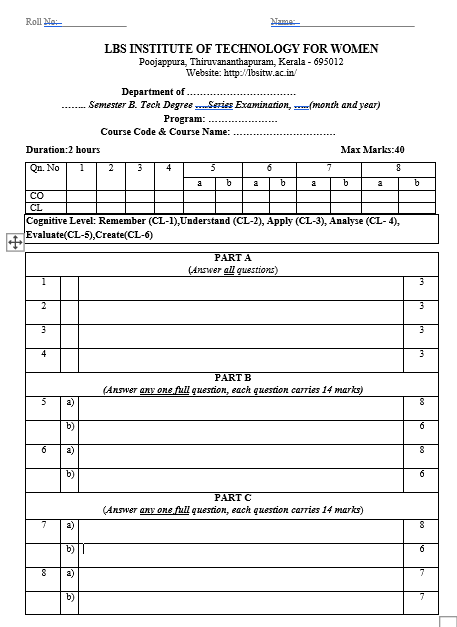
- Circulates the format of the question paper as given in Fig 1.
- Head of Department (HoD)
- Oversees department-level coordination and scheduling.
- Instructs faculty for paper setting, invigilation, and evaluation.
- Reviews CO–PO mapping and question paper quality.
- Faculty Members
- Prepare question papers mapped to Course Outcomes.
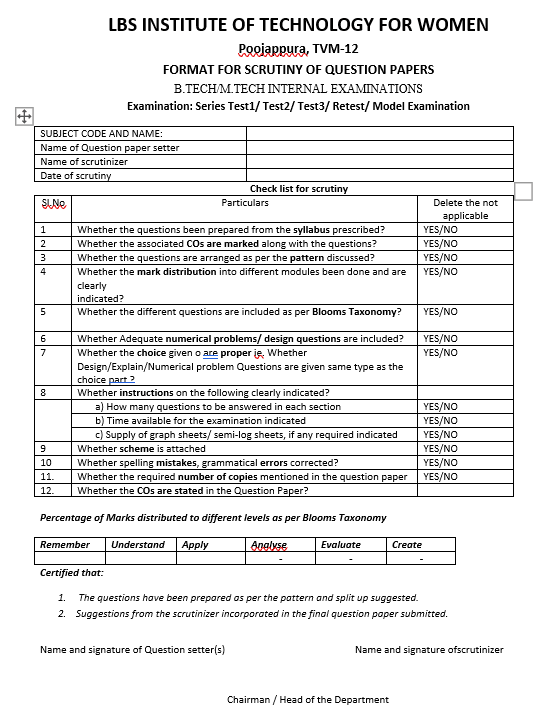
- Submit the question paper to the Program Assessment Committee (PAC) for scrutiny.
- Evaluate answer scripts fairly and within the stipulated time.
- Provide feedback and discuss common errors in class.
- Program Assessment Committee (PAC)
- Conducts the scrutiny of the question paper and ensures adherence to syllabus, COs, and Bloom’s Modified Taxonomy.
- Sends the scrutinized question paper to the Examination Cell.
- Examination Cell
- Coordinates the overall planning and conduct of internal examinations.
- Maintains records of question papers and attendance.
- Distributes answer scripts to the concerned faculty for evaluation.
- Students
- Attend all internal assessments and maintain academic integrity.
- Review evaluated answer scripts and provide feedback, if required.
6. Question Paper Preparation
Question papers must be original and outcome-based, covering all modules proportionately. Question paper should be prepared in the format given by the Dean Academics. The Course Outcomes (COs) mapped and the level of questions (based on Bloom’s Modified Taxonomy) should be mentioned in the question paper. The PAC verifies the question paper for syllabus coverage, question quality, and CO mapping.
7. Evaluation and Feedback
- Faculty shall complete evaluation within five working days of the examination.
- Marks and evaluated answer sheets must be shown to students for verification.
- CO-wise analysis of internal exam performance shall be carried out.
- Faculty shall provide constructive feedback to help students improve.
- Grievances related to marks shall be handled within three working days after publication.
- The marks are sent to the class tutor upon completion of solving any grievances, if any.
8. Attendance and Re-tests
- Attendance for internal exams is mandatory.
- Students absent due to genuine reasons (medical/emergency) may submit request for retest and documentary evidence of leave within two working days of returning to college.
- Doctor’s certificate has to be submitted in case of absence due to medical reason.
- The student may be permitted to take a re-test after approval from the HoD, covering the entire syllabus.
9. Result Compilation and Record Maintenance
- Departments shall maintain records of question papers, answer scripts, mark lists, and CO–PO attainment reports.
- Marks will be normalized and uploaded to the KTU CIE portal as per university deadlines.
10. Continuous Improvement and Review
IQAC and Department Academic Committee shall periodically review the internal examination process.
11. Code of Conduct During Examination
Students must carry valid ID cards and reach the exam hall on time.
Any form of malpractice will result in disciplinary action as per institutional regulations.
Invigilators shall maintain discipline and report any irregularities immediately.
12. Policy Review
This policy will be reviewed every two years or as directed by the Academic Council / Principal, to ensure compliance with the latest KTU and UGC guidelines. Version 2.0 integrates both the 2019 and 2024 KTU schemes.
Approved by: Academic Council, LBS Institute of Technology for Women, Thiruvananthapuram
Effective From: July 2024
Version: 2.0 (Incorporating 2019 and 2024 Schemes)
Prepared by
Internal Quality Assurance Cell
LBS Institute of Technology for Women (LBSITW)
Poojappura, Thiruvananthapuram, Kerala